


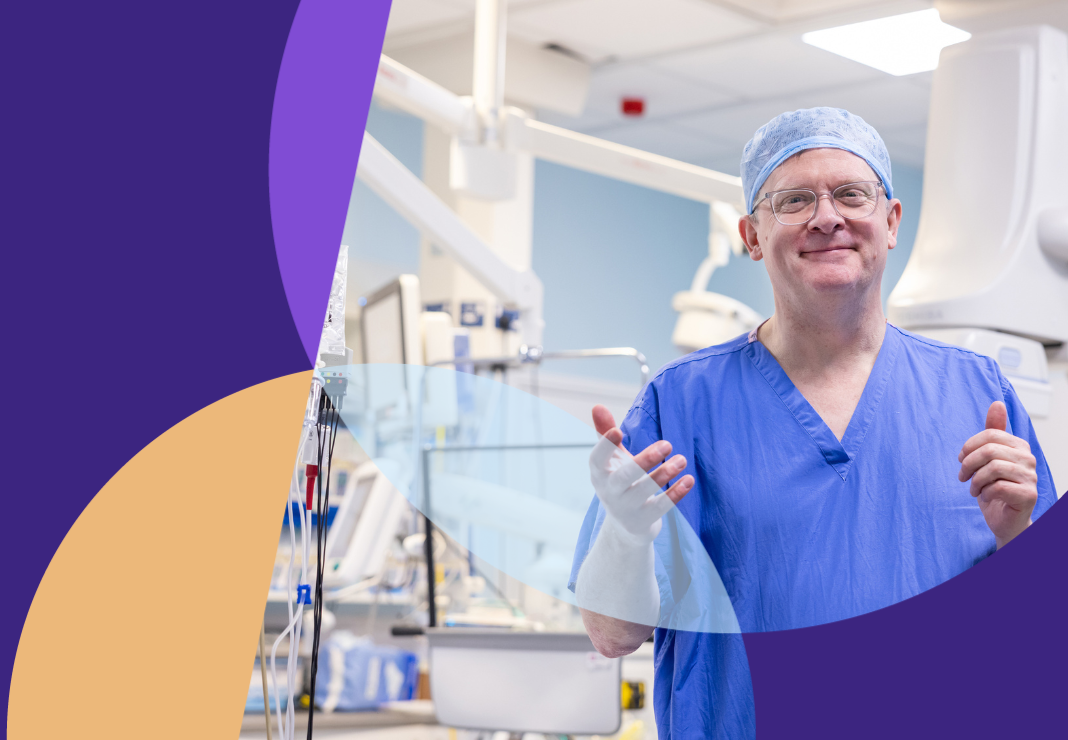
Coronary angiogram

About this page
- Last updated
About this diagnostic procedure
If your doctor thinks you might have a problem with your heart’s blood vessels, a coronary angiogram is a low risk and useful test. Based at the Sainsbury Wing, Hammersmith Hospital, we offer coronary angiograms to help identify narrowed or blocked blood vessels that carry blood to your heart to determine whether you need further treatment.
Who might need a coronary angiogram?
A coronary angiogram can help diagnose heart conditions, guide future treatment, and support certain procedures. It may be recommended to you:
- after a heart attack to check for blockages in the heart’s blood supply
- to diagnose angina where chest pain is caused by restricted blood flow to the heart
- to plan further treatment such as coronary angioplasty, a procedure to widen narrowed or blocked blood vessels
- to diagnose coronary heart disease, where fatty deposits build up in the coronary arteries and affect the heart’s blood supply
What to expect during the procedure
A coronary angiogram is carried out in a cardiac catheter laboratory, often known as a ‘cath lab’. Before the procedure you’ll be asked not to eat or drink a few hours. When you arrive, you will need to lie flat on a firm special table. The procedure usually takes about half an hour, although sometimes it can take a little longer.
In many cases, a very light sedative may be given but you will be awake throughout the procedure. To begin, a local anaesthetic will be injected into the skin around your wrist to numb the area. In a small number of cases, an anaesthetic may be injected into your groin. The doctor will then gently insert a thin, flexible tube called a catheter into one of your arteries. With the help of X-ray imaging, the catheter is gently guided through your blood vessels until it reaches your heart.
Once the catheter is in place, a special dye known as contrast is passed through it. As the dye moves through your hearts blood vessels, a series of X-ray images are taken. Your doctor will be standing with you throughout the procedure, observing your heart, the electrocardiogram (ECG) and the heart arteries. You may feel a brief hot, flushing sensation as the dye enters your bloodstream - this is completely normal and only lasts a few seconds. The dye helps highlight if of your arteries are narrowed or blocked.
You’ll be awake and able to talk to the medical team throughout the procedure. You’ll be connected to a heart monitor to track your heart rate and rhythm, and a small probe on your finger will measure your oxygen levels. If you feel anxious, you can ask for a mild sedative to help you relax.
As a coronary angiogram is a diagnostic procedure, in some cases the doctor can treat the heart arteries in the same procedure, which is known as a coronary angioplasty. During the coronary angiogram, further diagnostic information may be gained by using technologies such as a pressure wire that measures how well blood is flowing through your artery or intravascular coronary imaging that helps your doctor see exactly how much narrowing there is and what the artery looks like from the inside.
Once the procedure is complete, the tubes will be removed from your body and if your wrist has been used to access the artery, a special plastic bracelet will be placed around the hand area to help the area heal. In this instance, you can usually sit up very soon after the procedure. If your groin has been used to access the artery, a small collagen plug may be placed to stop any bleeding, and you will be asked to lie flat for a certain length of time.
After the procedure
Most people are able to go home on the same day as their coronary angiogram, once they’ve had some time to rest and be observed by the medical team. During this time, your observations will be taken and a routine ECG will be performed.
It’s important to arrange for a family member or friend to take you home, as you won’t be able to drive straight away.
It’s normal to feel a bit tired for a day or two after the procedure, and the area where the catheter was inserted, either your wrist or groin, may be tender for up to a week. Some bruising is normal and can last for a couple of weeks.
You’ll usually be advised to avoid certain activities, such as bathing and lifting heavy objects, for a day or two after the procedure. Driving should also be avoided until your medical team confirms it’s safe, which may be up to three days after your angiogram.
Results
After your coronary angiogram, your medical team will use the images to see how well blood is flowing through the arteries of your heart. This test can help your doctor:
- identify any arteries that are narrowed or blocked
- assess how much blood flow to or from the heart is affected
- detect whether there are any build-up of fats, cholesterol, or other substances in the artery walls - a condition known as atherosclerosis
- check the results of previous heart surgery
All of this information helps your doctor decide on the best treatment plan for you, making sure you get the care that’s right for your heart.
Why choose us?
When you come to us for a coronary angiogram, you’ll be looked after by a team of highly skilled and internationally renowned cardiologists, cardiac surgeons, and nurses. The broad expertise and vast experience of our cardiologists and cardiac surgeons make our cardiac services team one of the best in the UK. You will be cared for by highly skilled clinicians who have an in-depth practical knowledge of how to treat or prevent your heart condition in the safest way.
Through our multidisciplinary team approach, we combine best practices with innovative techniques to deliver the best possible treatment.
Find out more about coronary angiogram and get in touch
If you have any questions about coronary angiogram or would like to schedule a consultation, please contact us.
Call: +44 (0) 20 3311 7700
Email: imperial.private.healthcare@nhs.net
Most major insurance companies cover the cost of treatment.
Contact us today to find out more.

Patient testimonial
“All Dr Malik's TAVI team including the anaesthetist and nurses are absolutely wonderful, professional and caring. I am so pleased to have had my TAVI done here.”
TAVI patient at the Sainsbury Wing, Hammersmith Hospital, February 2024

Patient testimonial
“The TAVI procedure team were brilliant. I was put at ease and I was aware of their level of expertise and professionalism."
TAVI patient at the Sainsbury Wing, Hammersmith Hospital, June 2024